Thermal Imaging Roof Inspections
Detect Hidden Issues. Reduce Uncertainty. Improve Decision Accuracy.
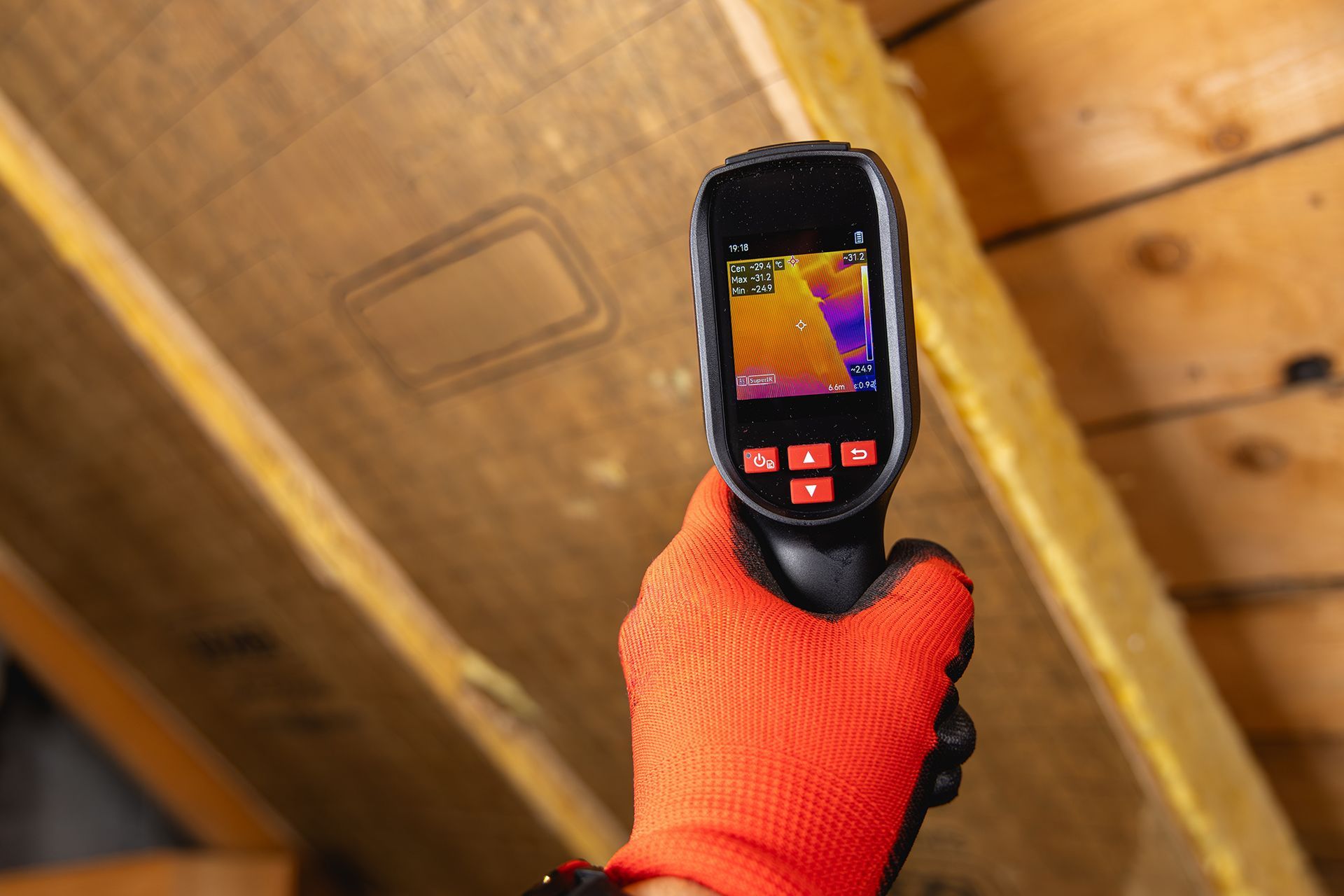
Thermal imaging is an inspection method that uses infrared technology to detect temperature differences within a roofing system. It is used to identify trapped moisture, insulation deficiencies, and hidden system failures that are not visible during standard inspections.
Not all roofing issues are visible.
Moisture intrusion, insulation breakdown, and system failure often develop beneath the surface—long before they show up as leaks or visible damage. By the time those signs appear, the impact is already greater.
Thermal imaging provides a way to identify those conditions earlier.
Crowther uses thermal imaging as a diagnostic tool to locate hidden issues, reduce uncertainty, and support more accurate repair and replacement decisions.
What Thermal Imaging Detects
Thermal imaging identifies conditions that cannot be seen through standard visual inspection.
This includes:
Trapped moisture within the roofing system
Saturated insulation
Areas of heat loss or inefficiency
Subsurface system failures
These conditions often exist before visible signs appear.
Why Early Detection Matters
Moisture and hidden system failures can spread over time.
If not identified early, they can:
Expand across larger areas of the roof
Reduce insulation performance
Accelerate system deterioration
Increase repair and replacement costs
Early detection allows for targeted action instead of large-scale correction.
Performance Advantages
Thermal imaging is used to improve both accuracy and efficiency in roof evaluation.
Key advantages include:
Non-invasive inspection
Evaluates system condition without removing materials or disrupting the roof.
Early problem identification
Detects issues before they become visible or require major repair.
Improved energy awareness
Identifies areas of heat loss that may impact building efficiency.
Support for predictive maintenance
Helps plan maintenance and repair based on actual system condition.
Integration with Roof Inspections
Thermal imaging is not used on its own—it supports a broader inspection process.
It is combined with physical evaluation to:
Confirm suspected problem areas
Identify hidden conditions
Refine repair scope
Improve accuracy in recommendations
This reduces guesswork and limits unnecessary work.
Application Across Commercial Systems
Thermal imaging is used across all major commercial roofing systems.
It is particularly valuable for:
- Large-scale flat roofing systems
- Multi-building properties
- Systems with recurring or unclear issues
- Pre-replacement condition evaluations
It provides clarity where standard inspection is limited.
Efficiency on Large Properties
For large commercial roofs, identifying isolated issues can be difficult.
Thermal imaging allows for:
- Faster identification of affected areas
- Reduced inspection time across large surfaces
- More efficient repair planning
- Better visibility at scale
This is especially valuable for multi-site portfolios.
When to Use Thermal Imaging
Thermal imaging is most effective when:
- Moisture intrusion is suspected
- Leaks are recurring without a clear source
- System condition needs to be verified
- Repair or replacement scope needs to be defined
It provides clarity before decisions are made.
Cost & Decision Support
Thermal imaging supports more controlled decision-making.
It helps:
- Avoid unnecessary full replacements
- Limit repairs to affected areas
- Improve accuracy of project scope
- Reduce long-term costs
The value comes from better information, not just inspection.
thermal imaging services Across Florida
Thermal imaging services are provided throughout Florida, including Fort Myers, Sarasota, Tampa, Jupiter, and surrounding markets.
This service is typically used as part of inspection, maintenance, or replacement planning.
Frequently Asked Questions
Does thermal imaging replace a standard inspection?
No. It supports inspections by identifying hidden conditions not visible during physical evaluation.
How accurate is thermal imaging?
It is highly effective for detecting moisture and temperature variation when used under the right conditions.
Can it detect all leaks?
It detects moisture presence, which helps identify potential leak areas, but additional evaluation may be required.
Is thermal imaging disruptive?
No. It is non-invasive and does not interrupt building operations.
When should thermal imaging be used?
When a more detailed understanding of roof condition is required before repair or replacement.