Blue Roof Tarps: Temporary Protection, Risks, and Limits
A professionally selected temporary cover can reduce further water entry. Its material, installation, condition, and follow-up matter more than whether it is blue.
Discuss your roofing project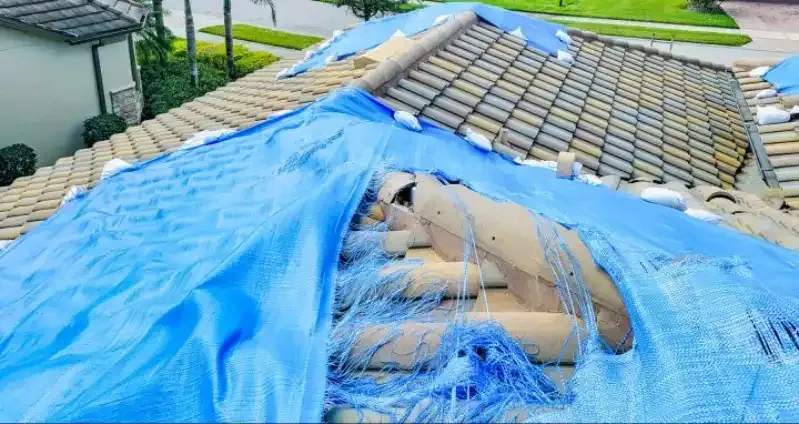
A temporary roof cover can help reduce further water entry after damage, but it does not replace a completed roof repair. Blue is a color, not a performance rating: different covers use different materials and installation methods. The right questions are whether the cover suits the damaged roof, whether it can be installed safely, how its condition will be monitored, and what happens next. Professional assessment helps connect temporary protection with a practical plan for permanent repairs.
In this guide
Temporary protection has a legitimate purpose
The U.S. Army Corps of Engineers describes Operation Blue Roof as a program using fiber-reinforced sheeting to protect qualifying storm-damaged roofs while permanent repairs are arranged. That is direct evidence that an appropriately selected and installed temporary cover can serve a useful purpose. It is not evidence that every sheet sold as a tarp will perform the same way on every roof. [1]
After severe weather in Fort Myers, an owner may need short-term protection before the full repair scope, materials, and schedule are settled. A temporary measure can address that gap. The contractor should still explain the limits of the proposed work and any roof condition that prevents a suitable installation. Covering an opening does not restore damaged framing or establish that a building is safe to occupy.
Keep private roofing work separate from disaster-assistance programs. Operation Blue Roof availability, geographic coverage, and eligibility depend on the active mission. Check current official information when assistance is being offered. A privately installed blue cover does not prove the installer represents the government or participates in that program, and this article does not imply that Crowther Roofing is an Operation Blue Roof contractor.
Evaluate the cover rather than its color
Two blue sheets can differ in reinforcement, construction, intended use, condition, and suitability for exposure. FEMA has distinguished loose self-help tarps from the reinforced covering installed through the USACE Blue Roof program. That distinction is more useful than treating the shared color as a technical specification. The homeowner needs to know what is actually being proposed. [2]
Ask the contractor to identify the temporary material, the roof area it is intended to protect, and the limits of the installation. Also ask what happens if the cover moves, tears, or stops controlling water entry. A description such as heavy duty should be supported by an understandable product and scope explanation rather than used as a promise of indefinite protection.
Consider a hypothetical Sarasota homeowner who has received two temporary-protection proposals. One identifies the product, affected area, follow-up contact, and removal scope. The other says only install blue tarp. Even before comparing prices, the second description leaves basic responsibilities unanswered. The practical difference is the completeness of the plan, not which shade of blue appears in the photograph. Do not assume a thicker-looking material alone resolves every installation question.
Installation must suit the actual roof condition
Shingle, tile, metal, and low-slope roofs present different surfaces and details. The damage may include more than a missing covering: broken decking, loose components, concealed openings, or unstable areas can affect whether and how temporary work can proceed. A qualified professional needs to evaluate those conditions before selecting an approach.
The owner should ask how the proposed attachment interacts with the existing roof and what repair will be needed when the temporary material is removed. An emergency measure may create work that must be included in the permanent restoration. That does not automatically make the measure wrong; it makes documentation and an appropriate removal plan important. Improvised weights, arbitrary fasteners, and a sheet stretched over an unknown opening are not substitutes for that judgment.
Do not climb onto a damaged roof to adjust a loose corner, inspect beneath the cover, or add restraints. The condition below the sheet may be hidden, and the cover itself is not a walking surface. Photograph what you can see safely from the ground and report movement or damage. If wind or rain is active, keep people away from the affected area and leave rooftop access to trained personnel when conditions allow.
A covered roof does not dry the interior
Temporary protection addresses additional water entry; it does not remove moisture that has already entered insulation, ceilings, walls, or contents. If those materials remain wet, the recovery work may require separate assessment and drying. The absence of new dripping is therefore useful information, but it is not proof that the entire affected area has recovered.
EPA identifies moisture control as the key to controlling mold and stresses prompt attention to water-damaged materials. That supports a practical distinction: mold risk comes from unresolved moisture, not from the color of a roof covering. It would be inaccurate to say every tarp creates mold or attracts pests. The actual roof and interior conditions need to be evaluated. [3]
For a hypothetical Jupiter home, a temporary cover might stop visible dripping while wet insulation remains above a stained ceiling. Painting that ceiling immediately would address appearance before the moisture question is resolved. Tell the contractor or restoration professional which rooms were affected and when the water appeared. Keep people clear of sagging ceilings and water near electrical equipment; those conditions require qualified help and should not be investigated by standing directly beneath the damaged area.
Set a follow-up plan while the cover is installed
Temporary work needs a person responsible for follow-up. Ask when the installation should be reassessed and what conditions require an earlier visit. There is no single useful lifespan for every roof cover because material, installation, exposure, roof condition, and subsequent weather differ. A date printed in an old disaster-program article is not a service-life guarantee for the cover on your home.
From a safe location, note new flapping, displaced sections, torn material, detached components, or renewed interior water. Report those changes promptly. Do not assume that a cover which handled one shower will handle every later storm. If access or weather prevents an immediate response, ask what interior precautions are appropriate for the observed condition without attempting rooftop corrections yourself.
Keep the temporary-work scope, invoice, photographs, installation date, and communication together. Where several companies are involved, identify who installed the protection and who will remove it. Make sure a roofing contractor arriving later knows what was attached and where. These records help coordinate the repair; they do not guarantee insurance reimbursement or establish the cause and extent of all storm damage by themselves.
Move from short-term protection to a defined repair
A useful temporary-work conversation ends with the next decision. What must be inspected once access is safe? What information is needed to specify permanent work? Is the affected area isolated, or does the scope remain uncertain? Who will contact the owner when the next step can proceed? A roof should not disappear from the schedule simply because a sheet now covers it.
The permanent scope should account for removal of the temporary material, the original damage, any attachment-related work, and the roof components exposed during repair. It should also distinguish roofing work from interior restoration. If the permanent project is delayed, revisit the protection plan instead of assuming the cover remains acceptable indefinitely.
Crowther Roofing provides storm-damage and emergency roofing services for Florida homeowners. If your Fort Myers, Sarasota, or Jupiter property has a temporary cover, share the installation information and describe any continuing leaks or visible changes. Request a roof evaluation that identifies the condition, appropriate next work, and how the temporary protection will be managed during the transition. The objective is to make the temporary measure part of a clear repair plan, with expectations that match the actual roof.
Frequently Asked Questions
Are all blue roof tarps ineffective?
No. Appropriate temporary coverings can help reduce additional water entry. Their suitability depends on the material, installation, roof condition, and exposure. Color alone does not establish whether a cover will perform well.
Does a blue tarp mean the government installed it?
No. Private contractors and homeowners also use blue coverings. Verify any claimed disaster-program affiliation through official program information rather than relying on the cover’s appearance.
How long can a temporary roof cover remain in place?
There is no universal period for every cover. Ask the installer about the specific product, inspection needs, exposure limits, and repair schedule. Reassessment may be necessary after additional weather or visible movement.
Should I adjust a loose tarp myself?
Do not climb onto a damaged roof or walk on a temporary cover. Document visible changes safely from the ground and contact the installer or a qualified roofing professional for assessment.
Does stopping the drip mean the ceiling and insulation are dry?
No. Materials may remain wet after additional water entry is reduced. Interior moisture assessment and drying can be separate needs, especially when insulation, ceilings, or wall cavities were affected.
What should the permanent repair scope include after temporary covering?
It should address removal of the cover, the underlying damage, relevant attachment-related repairs, and integration with the surrounding roof. Clarify which company handles each task and any separate interior-restoration work.
Technical references
- U.S. Army Corps of Engineers: Operation Blue Roof
- FEMA: Tarps and USACE Blue Roofs
- EPA: A Brief Guide to Mold, Moisture and Your Home
- Crowther Roofing: Original Blue Tarp Article
Use current source documents and confirm the requirements that apply to your property and project.
Plan the next step beyond a temporary roof cover
Share your property location and project goals with Crowther Roofing to discuss the scope and the next step.
Discuss your roofing project