

What Is Efflorescence on Concrete Roof Tile?
White haze may be efflorescence, but the diagnosis comes first. Understand the deposit before choosing a treatment for the roof.
Discuss your roofing project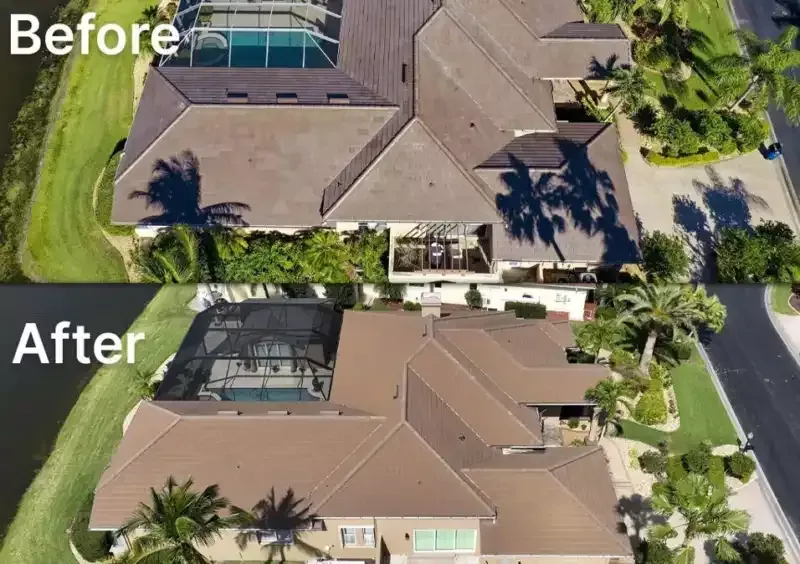
Efflorescence is a mineral deposit that can create a white haze or chalky patches on concrete roof tile. When that is the confirmed condition, it is generally a surface appearance issue rather than evidence that the tile has lost its strength. The important qualifier is confirmed: a white mark in a photograph is not enough to identify every stain or assess the rest of the roof. Understand the material and the deposit before paying for cleaning, coating, or replacement.
In this guide
Why concrete tile can develop a white deposit
Concrete contains cement, and cement-related compounds can move to the surface through a reaction involving moisture and carbon dioxide. Eagle Roofing explains that this can leave a pale crystalline deposit, either across an area or in concentrated patches. The effect may soften the apparent color of the tile without changing the underlying product in the way a crack or break would. That is the basic distinction behind the term efflorescence. [1]
For a homeowner, the practical consequence is that a change in appearance does not automatically call for replacing sound tile. A newly noticed white area may look especially dramatic against a dark finish. It deserves an explanation, but appearance alone does not tell you the work required. Ask whether the observation is consistent with the specific tile product and whether a manufacturer representative should be involved.
Keep the language precise. “There are white deposits on the north-facing slope” is a useful initial description. “The entire roof is deteriorating” is a conclusion that needs separate evidence. Likewise, a contractor should explain why the deposit is considered efflorescence rather than using the word as a convenient dismissal. A clear identification gives the owner a sound basis for deciding whether monitoring or an appearance-related service is appropriate.
Confirm the material and distinguish separate observations
Start with the roof's product information when it is available. Concrete tile, clay tile, and a previously coated surface should not be treated as interchangeable merely because they have a similar shape. Look for the installation invoice, product name, or records of later cleaning and coating. If those records are missing, ask the evaluator to identify what can be established and what remains uncertain.
Photographs help when they show both the overall slope and the specific area. Take them from a safe ground location or another normal occupied viewing position. Note whether the appearance was present after installation, appeared after a particular service, or has changed gradually. Do not scrape the surface, remove a tile, or apply a household chemical to test a theory. Those actions can change the evidence before someone has evaluated it.
Consider a hypothetical Palmer Ranch homeowner with a pale roof patch and an interior ceiling stain. The two observations should both be reported, but the pale patch should not automatically be named as the source of the indoor stain. Conversely, identifying a cosmetic deposit does not resolve the separate interior complaint. Ask the roofing professional to explain which finding relates to appearance and which requires additional investigation. That keeps a legitimate cosmetic explanation from being stretched into an unsupported statement about the whole roof.
Monitoring can be a deliberate choice
Eagle's guidance describes efflorescence as a process that often becomes less visible through weathering, with timing affected by the deposit and local conditions. It does not justify promising that every roof will return to an identical appearance by a fixed date. If the deposit is confirmed and no separate concern requires work, allowing the process to continue may be more appropriate than immediately treating the surface. [2]
Ask the evaluator what changes would justify another review. The answer should distinguish a developing appearance concern from separate physical symptoms, such as newly observed broken material or an interior water issue. A short written finding is useful: what was reviewed, what the deposit was identified as, and whether any other condition remained unresolved. That record gives the monitoring decision a reason behind it.
For your own comparison, use similar viewing locations and lighting when taking later photographs. A wet roof, low-angle sunlight, or a different camera exposure can make the same area look substantially different. You do not need a complicated inspection archive. A few dated, clearly labeled pictures and the evaluation notes are enough to avoid relying on memory. For a Fort Myers seasonal property, share those notes with the person looking after the home so a cosmetic change does not repeatedly trigger a new and conflicting explanation.
Discuss appearance treatment before anyone cleans or seals
Some owners are comfortable waiting; others have appearance concerns tied to a sale, renovation, or community review. Explain the reason for requesting treatment so the contractor can address the actual objective. A cosmetic service should still be based on the identified surface and manufacturer guidance. Do not approve an aggressive cleaning method simply because it promises to make every mark disappear quickly.
Eagle recommends qualified professionals for roof cleaning and identifies the need to avoid damaging the tile surface. Its efflorescence guidance also cautions against sealing while remaining salts may still be emerging. These are reasons to review the proposed method and timing for the actual roof, rather than treating a generic roof-cleaning package as suitable for every white deposit. [2] [3]
Ask which material is being treated, what result is realistic, whether a limited trial area is appropriate, and what uncertainty remains. Have the contractor explain how nearby finishes, landscaping, and the roof itself will be protected. Any follow-on coating or sealer should be separately identified and justified. You should know whether the proposal is intended to remove a deposit, alter the appearance, or address an independent condition. Those are different objectives and should not be bundled under an unexplained claim that the roof needs to be restored.
Keep the condition decision separate from the color decision
A roof has more to evaluate than the visible color of its tile. A cosmetic deposit does not establish the condition of the components beneath or around it, and an attractive surface does not prove those components need no attention. If the owner requested a broader roof evaluation, the resulting report should address that scope independently of the discoloration. If only the deposit was reviewed, the limitation should be clear.
This also matters when comparing proposals. One contractor may be quoting cleaning for appearance while another is quoting repairs to a separate observed defect. Ask both to identify the condition each line item addresses. Otherwise, the numbers appear to compete even though they describe different work. Manufacturer guidance about efflorescence should not be used to support unrelated repairs, and an unrelated repair should not become a reason to replace every tile with a pale patch.
Crowther Roofing can evaluate visible tile conditions and help determine whether further inspection or a cleaning discussion is appropriate. For a Fort Myers or Sarasota roof with white deposits, provide the product records, the history of the appearance change, and photographs taken safely. Request a clear identification of the deposit and a recommendation tied to that finding. The aim is a decision you can explain: monitor a confirmed cosmetic condition, consider compatible appearance treatment, or investigate a separate concern that has its own evidence.
Frequently Asked Questions
Does every white mark on a concrete roof tile count as efflorescence?
No. White color alone does not establish the cause. Product information, surface condition, appearance history, and professional evaluation help distinguish a mineral deposit from other residue or a separate finish concern.
Does confirmed efflorescence mean the concrete tile needs replacement?
Usually not for that condition alone. Manufacturers describe confirmed efflorescence as superficial. Broken tile, other physical defects, or separate roof concerns should be evaluated independently rather than inferred from the white deposit.
How long should I expect the white haze to remain?
There is no reliable deadline for every roof. The amount and type of deposit and local exposure affect weathering. Ask for a product-specific recommendation and an explanation of when another review would be useful.
Should I seal the tile to stop the white marks?
Do not make that decision before the deposit is identified. Manufacturer guidance may favor allowing the process to finish, and an unsuitable or premature treatment can create a different appearance problem. Review the exact method and timing.
Can I clean one tile with a household chemical as a test?
That is not a useful first step. It may alter the finish or the evidence needed for evaluation. Ask a qualified professional about a compatible method and whether a controlled trial area is appropriate.
If the white deposit is cosmetic, can I ignore a nearby ceiling stain?
No. An interior stain is a separate observation that needs an appropriate assessment. Identifying efflorescence does not establish the cause of a leak or confirm the condition of hidden roofing components.
Technical references
- Eagle Roofing: What Is Efflorescence and How It Affects Your Concrete Tile Roof
- Eagle Roofing: Efflorescence, Debunking the Myths
- Eagle Roofing: Frequently Asked Questions
- Crowther Roofing: Original What is Efflorescence?
Use current source documents and confirm the requirements that apply to your property and project.
Identify the white deposit before treating the tile
Share your property location and project goals with Crowther Roofing to discuss the scope and the next step.
Discuss your roofing project